Licensing and version upgrades
丰盘ECM follows the freemium model common among enterprise software vendors: a free Community Edition plus paid subscription add-ons. The Community Edition is free forever, with no user limit and no time limit, and it covers the most basic needs such as centralized file storage and team sharing, replacing common file sharing services like Windows shares, FTP, or SVN. The Premium Edition offers differentiated paid features through an on-demand plugin marketplace, so large enterprises and teams can meet deeper, individual needs such as full-text search, audit logs, and file tag management. Premium Edition pricing is transparent and uniform, and customers can apply for a Premium Edition trial on the service portal.
Community Edition vs. Premium Edition
For more differences between the editions, see 丰盘ECM pricing: Community Edition vs. Premium Edition.
To check Premium Edition pricing and further details online, sign in to the service portal.
System instance, version, and license information
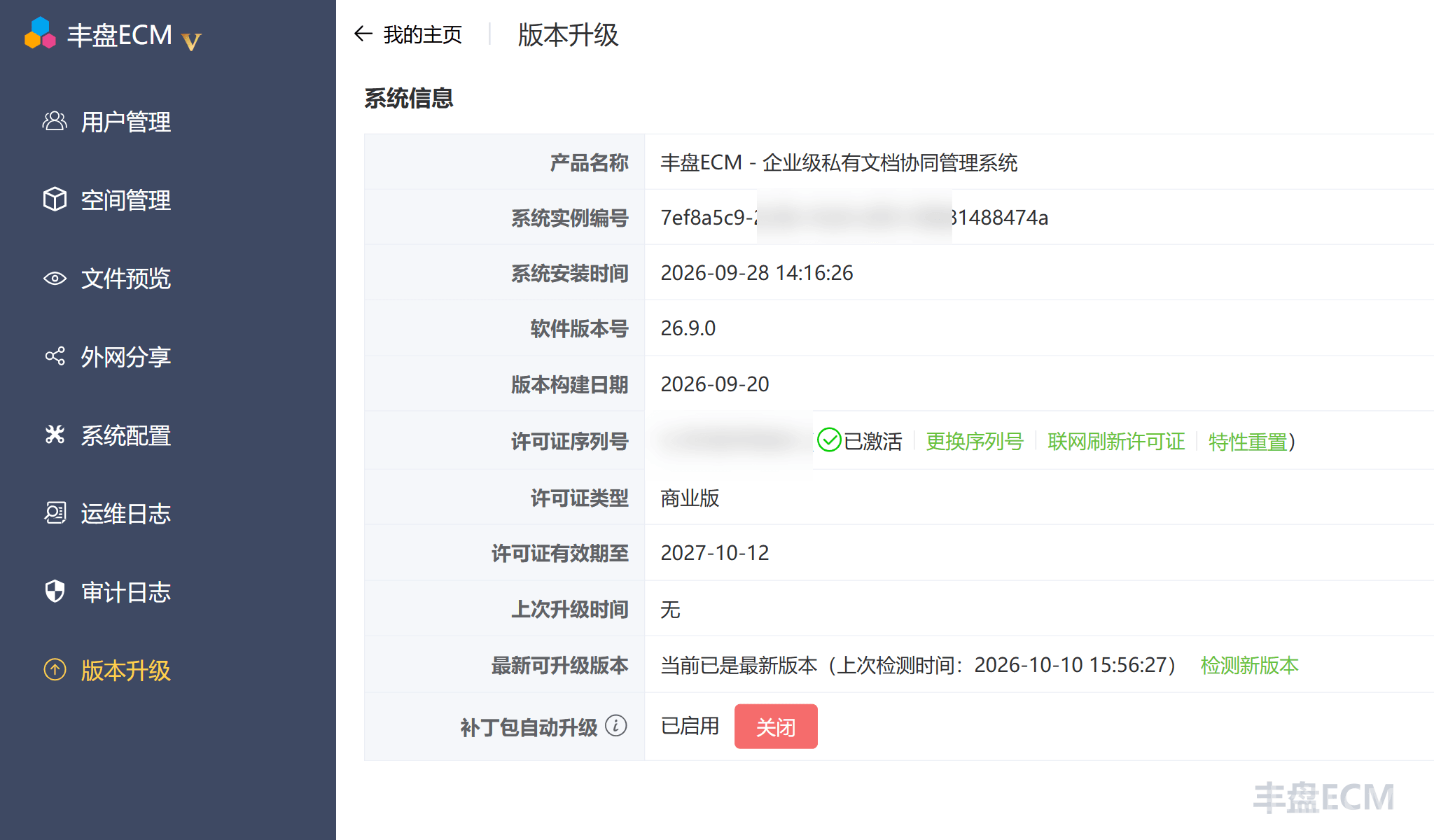
Sign in to "Admin Console" and open the "Version Upgrade" page to view the instance GUID, version details, and bound serial number of the installed system. Every installation has a globally unique identifier. When you activate the system with a license, we record the instance ID in the customer database and bind the corresponding license.
Large enterprises may install several systems for different teams, so our support team may ask for your system instance ID. If your license is about to expire, sign in to our online service portal, submit a renewal request, then click "Refresh License Online" on the "Admin Console / Version Upgrade" page of your on-premises system to download the latest license file to the server. A license that is not renewed expires and cannot be renewed afterward, so the customer must apply for a new license.
After you purchase a Premium Edition license and enter its serial number, the system activates the associated features automatically.
Free Community Edition license quota
Usually a customer needs only one license to use our product indefinitely, as long as it is renewed in time to avoid expiry. Within 30 days of the expiry date, users see a renewal reminder when they sign in. The enterprise administrator must sign in to the "online service portal", submit the renewal request, and then download the latest license file from the local system. The Community Edition license keeps working, no serial number change is needed, and it still uses only one free license.
Somewhat larger enterprises may deploy a separate system per department, or the IT department may run an independent test environment for risk control. These cases require additional licenses.
Free Community Edition licenses are limited: one legal entity, including affiliated companies, can apply for at most one license. Requests beyond the quota are declined, and you need to buy the Premium Edition or migrate to another system. If a license has already expired and migration cannot be completed, we issue a temporary license for you.
Activation limits across servers
After you activate a license on a test server and verify that the system meets your organization's needs, you can deploy a fresh installation on a production server without applying for another license. Use the existing serial number to activate the system on the new server.
A license can activate up to 10 servers (Community Edition renewals have no limit and remain free). However, a license can be bound to only one server at a time. The enterprise administrator must sign in to the "丰盘 online service portal" and manually scrap the old system instance to release the serial number for a new installation. Otherwise activation fails with an error saying the license serial number is already bound. Do not keep using the system on the old server after scrapping its instance; once the old system detects the scrapped state, its local license becomes invalid automatically.
If you need to deploy several 丰盘 systems in parallel and use them long term, purchase a license for each one.